

Where Is Majority Of Makeup Produced
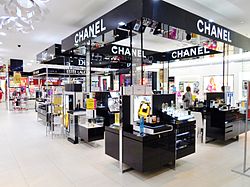
The cosmetic industry describes the industry that manufactures and distributes cosmetic products. These include color cosmetics, like foundation and mascara, skincare such as moisturisers and cleansers, haircare such every bit shampoos, conditioners and hair colours, and toiletries such equally chimera bath and soap. The manufacturing manufacture is dominated by a small-scale number of multinational corporations that originated in the early 20th century, but the distribution and sale of cosmetics is spread among a wide range of different businesses. The largest cosmetic companies are Johnson & Johnson, L'Oreal Paris, Gillette, Neutrogena, Nivea and Chanel, Inc.[ citation needed ] The market place volume of the cosmetics manufacture in Europe and the United States is virtually EUR €70b per year, according to a 2005 publication.[one] The worldwide cosmetics and perfume industry currently generates an estimated annual turnover of United states of america$170 billion (according to Eurostaf – May 2007). Europe is the leading market, representing approximately €63 billion[ as of? ].
By region [edit]
Americas [edit]
U.s. [edit]
Within the U.s., the state of California has the largest concentration of beauty establishments in America at 25.5%, followed by New Jersey at 8.i% of American beauty establishments.[ii] Since 2016, the number of corrective stores rises between 3 and 4% each year and employment in this division is ascent each year xiii-16%.[ commendation needed ]
California has the largest concentration due to social media marketing from celebrities and 'dazzler gurus'. For example, Kylie Jenner's visitor Kylie Cosmetics, is valued at $800 million and sold an estimated $330 1000000 worth of makeup in 2017. YouTube and social media influencers Jeffree Star (Jeffree Star Cosmetics), and Michelle Phan (Ipsy), and pop-star Rihanna with her Fenty Beauty line of cosmetics, have also contributed to California's rise popularity in the beauty industry.[ citation needed ]
Because the Usa dollar is so valuable to other countries effectually the globe, information technology has get extremely expensive for most countries to import American beauty products and to consign their ain products to America. Notwithstanding, there are a few countries with beauty products that are in popular demand in America due to their quality and value including France, Canada, Italian republic, and the United kingdom. Every bit of 2018, "These four countries account for 45.2% of all industry imports equally domestic consumers demand luxury products".[2] South Korean and Japanese skincare products which are designed to be more gentle and innovative, are likewise becoming more popularized in the U.s. due to their quality and affordability. The U.South has held the aforementioned regulation over this industry since 1938 under the FD&C Act, which has gained additional amendments over fourth dimension.[3]
Canada [edit]
Canada is a big influencer in the American beauty industry due to its proximity to the United States and because it falls under the North American Costless Trade Agreement (NAFTA). This understanding "eliminates most tariffs on products traded between Canada, United mexican states, and the United States,"[iv] and allows Canada to merchandise superfluously. Canada accounts for an estimated 13.6% of imports and 19.ix% of cosmetic exports in 2018.[2] [ commendation needed ]Because Mexico also benefits from the NAFTA merchandise agreement, they represent another height cosmetic importer and exporter for lower-priced beauty products which are manufactured in mass and sold in large drug store chains in America.[ citation needed ]
Europe [edit]
France [edit]
Cosmetic sales in French republic reached €6.five billion in 2006, according to FIPAR (Fédération des Industries de la Parfumerie – the French federation for the perfume industry).[5] France is another state in which the cosmetic manufacture plays an important role, both nationally and internationally. Most products with a label, "Made in French republic" are valued on the international market. Co-ordinate to data from 2008, the cosmetic industry has grown constantly in French republic for 40 consecutive years. Famous cosmetic brands produced in French republic include Vichy, Yves Saint Laurent, Yves Rocher, Bioderma and L'Oreal. L'Oreal is known for its mass production of hair and makeup products which are produced in mass and sold in drug stores in America as well as internationally. 50'Oreal has gained popularity especially due to its app Makeup Genius which allows users to try on makeup using their phone photographic camera in add-on to working with Los Angeles-based NYX Cosmetics and Estee Lauder's MAC Cosmetics, L'Oreal is i of the leading cosmetic brands in the U.s.. Co-ordinate to the company's latest financial written report of 2017, North America deemed for xiii.6% of the visitor'due south global cosmetic sales.[6]

Federal republic of germany [edit]
In Germany, the cosmetic manufacture generated €12.six billion of retail sales in 2008,[6] which, at the time, made the High german cosmetic industry the third largest in the earth after Japan and the Us. Information technology has been shown that Germany'south cosmetic industry grew nearly five percent in ane year, from 2007 to 2008. German exports in this industry reached €five.8 billion in 2008, whereas imports of cosmetics totaled €3 billion.[6] Germany gains near of its imported cosmetics from France, Switzerland, the United States and Italia.[ citation needed ]
Italy [edit]
Belarus [edit]
The Belarusian cosmetics market consists of Belarusan companies. At that place are more than 20 cosmetic companies in Belarus - Belita, Vitex, Lux Visage, Mastige, Modum, Rekish Cosmetics. The volume of the cosmetic market is more than 300 one thousand thousand euros per year.[ citation needed ]
Asia [edit]
The cosmetic manufacture in Asia is mainly dominated by regional cosmetic brands. Shiseido Co. LTD, A pop cosmetic brand based in Japan, has 82.1% of its sales in Asia.[7] No other Western visitor in the tiptop x match these kinds of regional sales. Furthermore, geographic dispersion of sales by Asian corrective companies in Asia accounted for 92.42% of sales, while geographic dispersion of assets of Asian cosmetic companies in Asia was 87.05%.[7] Western cosmetic companies oftentimes have failed to gain footholds in various countries. For example, in Japan, many advertisement campaigns that find success in the West, such as celebrity appearances and references to science, did not sway a sample group of respondents to purchase the foreign brands.[8] However, despite the lack of Western corrective presence, the growing trend of "off-white skin", or whiting ane'due south skin, tin can expose consumers skin to harmful chemicals when using "fairness creams".[9]
Due to recent significant economical growth in many Asian markets, regulation pertaining to chemicals in corrective products has been lacking. SK-2, a cosmetic product endemic by P&Grand, was institute to contain banned heavy metals in Cathay in 2006.[10] Some other study found that women who had recently moved to Vancouver, Canada from East and South Asia had higher levels of lead in their blood than S and Eastward Asian immigrants who had been living in Canada for longer.[eleven] One of sources of pb was determined to exist some facial powders marketed in diverse regions of Asia.[12]
Fashion designer collaboration [edit]
Due to the popularity of cosmetics, especially fragrances and perfumes, many designers who are non necessarily involved in the cosmetic manufacture came up with different perfumes carrying their names. Moreover, some actors and singers accept their ain perfume line (such every bit Celine Dion). Designer perfumes are, similar whatever other designer products, the most expensive in the industry every bit the consumer pays non merely for the product only as well for the make.[ citation needed ]
Marketing [edit]
The cosmetic manufacture worldwide seems to exist continuously developing, now more than than ever with the advent of the Internet companies. Many famous companies sell their corrective products online also, in countries in which they do not have representatives.
Research on the email marketing of cosmetics to consumers suggests they are goal-oriented with email content that is seen every bit useful, motivating recipients to visit a store to exam the cosmetics or talk to sales representatives. Useful content included special sales offerings and new product data rather than information nearly makeup trends.[13]
Controversies [edit]
Colorism [edit]
Many companies advertise white or light skin as not simply a cosmetic change, but a lifestyle change. White beauty implies a lifestyle of "sophistication, beauty, power, and wealth." Mass advertising and marketing from the US and Europe, as well as multiple mass media forms are used to reach other cultures to influence their purchasing habits. Many of the skin lightening products sold usually have celebrity endorsements, further increasing sales and the desire for lighter skin. These products can cause serious damage to skin and pose a wellness adventure to the consumer.[14]
In a written report done by S. S. Agrawal and Pallavi Sharma on xi skin lightening products sold in Bharat, information technology was constitute that "mercury was detected in all the samples of the skin lightening creams in the range of 0.14–0.36 ppm." This study also observed that none of the brands tested include mercury as an ingredient on the packaging, which may mislead consumers regarding health risks. In a report by the World Health Organization, it was stated that "skin whitening products tin can cause leukemia, liver and kidney cancer and could as well event in astringent peel atmospheric condition."[xv] Though these health risks exist, women of color in many parts of the world are purchasing skin lightening creams.
Choma and Prusaczyk's survey of women of colour in the US and Bharat "bear witness[s] that chronic surveillance of skin tone predicts peel tone dissatisfaction and skin bleaching." Some companies in the cosmetic industry have capitalized off of the cultural force per unit area and standards for having lighter skin. This study concluded that "skin bleaching is not simply a physical or aesthetic change, but one with potentially wide-ranging implications on psychological well-being and, more than broadly, the perpetuation of racist ideologies and beauty standards."[sixteen]
Touch on on surround [edit]
Some components found in cosmetics, as well as their production, accept been found to have negative environmental impact.[17] [eighteen] [19] [xx] For example, Palm oil is establish in lipstick, and shampoo. Palm oil is continued to the destruction of forests and habitats of endangered species, including orangutans, tigers, elephants, and rhinos.[21] [22]
Animal testing [edit]
Fauna testing has been a big controversy in the cosmetic manufacture. Brute tests performed include the Draize eye irritancy examination, where exam chemicals are applied to rabbits' eyes and left on for several days,[23] and toxicity tests such as LD50, where a substance'south toxicity is tested past determining the concentration at which information technology will kill fifty% of the test animals.[24]
Due to public outcry likewise as financial and temporal considerations, animal testing in cosmetics has steadily been decreasing over fourth dimension and replaced with non-animal tests.[25] One of these not-beast tests is the Environmental Protection Bureau's ToxCast which has a similar accuracy compared to animal tests simply achieves results with fewer economic costs and less fourth dimension.[25]
An European union ban of marketing cosmetic products which accept been tested on animals became effective in 2013.[26] There are a few exceptions to this law. Animal testing data for cosmetics can be used if the data for the ingredient used in the corrective originated from testing for non-cosmetic products.[26] Secondly, if a state outside of the Eu requires brute testing and the corrective product was tested in that country, the ban besides does non apply.[26] Cosmetic tests on animals are still legal in several countries, such as the US, Nippon, Russia,[25] and China.
There are a number of cosmetics companies that claim they are "cruelty-gratis," such equally Bathroom & Trunk Works, Aveda, ELF, and Milani,[27] just some debate that because the characterization of "cruelty-free" both lacks regulation and standardized third-party certification, it has trivial existent weight.[23] Brands that claim to exist cruelty free oftentimes advertize this with a logo of a rabbit on their products.
In some cases, cosmetic testing is done on humans, which also leads to a related give-and-take of best practices and ethics.[28]
Labor rights and trunk politics [edit]
A number of studies have focused on social issues such as labor rights and sociology of the trunk.[29] [xxx] [31] Research has found that some retail stores have discriminatory hiring practices and prefer to hire class-privileged workers to promote their upscale paradigm.[32]
See besides [edit]
- Animal–industrial complex
- Beauty salon
- Beauty store
- Wild animals smuggling
References [edit]
- ^ Schneider, Günther; Gohla, Sven; Schreiber, Jörg; Kaden, Waltraud; Schönrock, Uwe; Schmidt-Lewerkühne, Hartmut; Kuschel, Annegret; Petsitis, Xenia; Pape, Wolfgang; Ippen, Hellmut; Diembeck, Walter (2001). "Pare Cosmetics". Ullmann'southward Encyclopedia of Industrial Chemical science. doi:10.1002/14356007.a24_219. ISBN3527306730.
- ^ a b c "Industry Research Reports". www.ibisworld.com.au . Retrieved 2019-03-25 .
- ^ Salvador, Amparo; Chisvert, Alberto (2017). Assay of Cosmetic Products. Elsevier. ISBN978-0-444-63516-vii. [ page needed ]
- ^ "NAFTA'due south Economical Bear on". Council on Strange Relations . Retrieved 2019-03-25 .
- ^ "France continues to lead the way in cosmetics". Retrieved 2010-08-04 .
- ^ a b c "Cosmetic Industry". Archived from the original on 2010-09-08. Retrieved 2010-08-04 .
- ^ a b Oh, Chang Hoon; Rugman, Alan M. (April 2006). "Regional Sales of Multinationals in the World Cosmetics Industry" (PDF). European Direction Journal. 24 (2–three): 163–173. doi:10.1016/j.emj.2006.03.006.
- ^ Barnes, Bradley; Yamamoto, Maki (28 April 2008). "Exploring international cosmetics advertizing in Japan". Journal of Marketing Management. 24 (iii–four): 299–316. doi:10.1362/026725708X306112. S2CID 167830492.
- ^ Shankar, P. Ravi; Giri, Bishnu Rath; Palaian, Subish (25 July 2006). "Fairness Creams in South Asia—A Case of Disease Mongering?". PLOS Medicine. 3 (seven): e315. doi:10.1371/journal.pmed.0030315. PMC1518681. PMID 16848620.
- ^ Tai, Susan H. C. (June 2008). "Dazzler and the Beast: The Brand Crisis of SK-II Cosmetics in Mainland china". Asian Case Research Journal. 12 (1): 57–71. doi:ten.1142/S0218927508001023.
- ^ Dix-Cooper, Linda; Kosatsky, Tom (Apr 2018). "Claret mercury, lead and cadmium levels and determinants of exposure among newcomer Due south and East Asian women of reproductive historic period living in Vancouver, Canada". Science of the Full Surroundings. 619–620: 1409–1419. Bibcode:2018ScTEn.619.1409D. doi:ten.1016/j.scitotenv.2017.11.126. PMID 29734617.
- ^ Iqbal, MP (Jan 2012). "Lead pollution - a gamble factor for cardiovascular illness in Asian developing countries". Pakistan Journal of Pharmaceutical Sciences. 25 (one): 289–294. PMID 22186343.
- ^ Martin, Brett A. S.; Van Durme, Joël; Raulas, Mika; Merisavo, Marko (September 2003). "Email Advertising: Exploratory Insights from Finland". Periodical of Advertizement Research. 43 (iii): 293–300. doi:10.1017/s0021849903030265.
- ^ Hunter, Margaret L. (1 June 2011). "Buying racial majuscule: skin-bleaching and cosmetic surgery in a globalized world" (PDF). Journal of Pan African Studies. 4 (4): 142–165. Gale A306514739.
- ^ Agrawal, Due south.South.; Sharma, Pallavi (March 2017). "Electric current status of mercury level in skin whitening creams". Current Medicine Research and Practice. 7 (2): 47–fifty. doi:10.1016/j.cmrp.2017.02.001.
- ^ Harper, Kathryn; Choma, Becky L. (June 2019). "Internalised White Platonic, Peel Tone Surveillance, and Hair Surveillance Predict Skin and Hair Dissatisfaction and Skin Bleaching amidst African American and Indian Women". Sex Roles. 80 (11–12): 735–744. doi:10.1007/s11199-018-0966-9. S2CID 150156045.
- ^ Dhanirama, Danelle; Gronow, Jan; Voulvoulis, Nikolaos (2012-07-01). "Cosmetics as a potential source of ecology contamination in the UK". Ecology Technology. 33 (fourteen): 1597–1608. doi:10.1080/09593330.2011.640353. ISSN 0959-3330. PMID 22988620. S2CID 19751576.
- ^ Csorba, Luiela Magdalena; Boglea, Vanina Adoriana (2011-02-15). "Sustainable cosmetics: a major instrument in protecting the consumer's interest". Regional and Business Studies. 3 (ane Suppl): 167–176. ISSN 2732-2726.
- ^ Guerranti, C.; Martellini, T.; Perra, G.; Scopetani, C.; Cincinelli, A. (2019-05-01). "Microplastics in cosmetics: Environmental issues and needs for global bans". Environmental Toxicology and Pharmacology. 68: 75–79. doi:10.1016/j.etap.2019.03.007. ISSN 1382-6689. PMID 30877953. S2CID 81977316.
- ^ Prothero, Andrea; McDonagh, Pierre (1992-04-01). "Producing Environmentally Adequate Cosmetics? The Impact of Environmentalism on the United kingdom Cosmetics and Toiletries Industry". Journal of Marketing Direction. 8 (2): 147–166. doi:10.1080/0267257X.1992.9964186. ISSN 0267-257X.
- ^ Products containing palm oil
- ^ Tullis, Paul (19 February 2019). "How the world got hooked on palm oil". The Guardian.
- ^ a b Winders, Delcianna J (April 2006). "Combining Reflexive Constabulary and Fake Advertizement Law to Standardize 'Cruelty-Gratuitous' Labeling of Cosmetics". NYU Law Review. 81 (one).
- ^ Rowan, Andrew (1 January 1983). "The LD50--The Get-go of the Stop". Experimentation Collection.
- ^ a b c Rowan, Andrew N. (October 2015). "Ending the Utilize of Animals in Toxicity Testing and Risk Evaluation". Cambridge Quarterly of Healthcare Ethics. 24 (4): 448–458. doi:ten.1017/S0963180115000109. PMID 26364779. S2CID 5720148. ProQuest 1711663923.
- ^ a b c Fischer, Kristian (Dec 2015). "Animal Testing and Marketing Bans of the Eu Cosmetics Legislation". European Periodical of Risk Regulation. 6 (4): 613–621. doi:x.1017/S1867299X00005158. S2CID 168066036. ProQuest 1752184361.
- ^ "These Companies DON'T Test on Animals". PETA. January 13, 2016. Retrieved March 25, 2019.
- ^ Pauwels, Yard.; Rogiers, V. (2004-06-15). "Safety evaluation of cosmetics in the EU: Reality and challenges for the toxicologist". Toxicology Letters. 151 (1): 7–17. doi:10.1016/j.toxlet.2004.01.026. ISSN 0378-4274. PMID 15177635.
- ^ Baldoz, Rick; Koeber, Charles (2009). The Disquisitional Study of Work: Labor, Applied science, and Global Production. Temple University Printing. ISBN978-1-59213-809-eight.
- ^ Lan, Pei-Chia (2003). "Working in a Neon Cage: Bodily Labor of Cosmetics Saleswomen in Taiwan". Feminist Studies. 29 (ane): 21–45. ISSN 0046-3663. JSTOR 3178467.
- ^ Otis, Eileen (2016-02-01). "Mainland china'due south Dazzler Proletariat: The Body Politics of Hegemony in a Walmart Cosmetics Department". Positions: Asia Critique. 24 (ane): 155–177. doi:10.1215/10679847-3320089. ISSN 1067-9847. S2CID 147443582.
- ^ Lan, Pei-Chia (2003). "Working in a Neon Cage: Bodily Labor of Cosmetics Saleswomen in Taiwan". Feminist Studies. 29 (1): 21–45. ISSN 0046-3663. JSTOR 3178467.
Farther reading [edit]
- Wintertime, Ruth (2005) [2005]. A Consumer's Dictionary of Corrective Ingredients: Complete Information Almost the Harmful and Desirable Ingredients in Cosmetics (Paperback). US: Three Rivers Press. ISBN1-4000-5233-5.
- Begoun, Paula (2003) [2003]. Don't Go to the Cosmetics Counter Without Me(Paperback) . United states: Kickoff Press. ISBN1-877988-30-8.
- Carrasco, Francisco (2009) [2009]. Diccionario de Ingredientes Cosmeticos(Paperback) (in Spanish). Spain: www.imagenpersonal.internet. ISBN978-84-613-4979-1.
- Etcoff, Nancy L.; Stock, Shannon; Haley, Lauren E.; Vickery, Sarah A.; House, David M. (2011). "Cosmetics equally a Characteristic of the Extended Human Phenotype: Modulation of the Perception of Biologically Important Facial Signals". PLOS I. 6 (10): e25656. Bibcode:2011PLoSO...625656E. doi:10.1371/journal.pone.0025656. PMC3185017. PMID 21991328.
- Louis, Catherine Saint (12 October 2011). "Up the Career Ladder, Lipstick In Hand". The New York Times.
Source: https://en.wikipedia.org/wiki/Cosmetic_industry
Posted by: landissclows1999.blogspot.com
0 Response to "Where Is Majority Of Makeup Produced"
Post a Comment