

What Is The Ethnic Makeup Of Costa Rica?
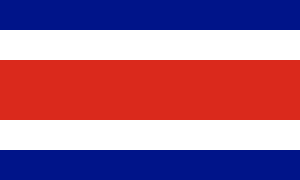 Flag of Costa Rica | |
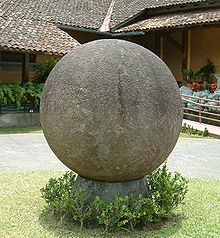 Stone sphere created by the Diquis culture in the courtyard of the National Museum of Costa rica. The sphere is the icon of the country's cultural identity. | |
| Total population | |
|---|---|
| five.075 meg | |
| Regions with meaning populations | |
 Republic of costa rica 5.075 million Republic of costa rica 5.075 million | |
 United states United states | 99.285[1] |
 Nicaragua Nicaragua | 11.283[1] |
 Panama Panama | 8.260[1] |
 Canada Canada | iv.206[1] |
 Spain Spain | three.459[one] |
 Mexico Mexico | iii.272[one] |
 Republic of chile Republic of chile | 1.841[1] |
 Brazil Brazil | i.833[ii] |
 Germany Germany | i.748[1] |
 Italia Italia | one.619[1] |
 Guatemala Guatemala | 1.192[1] |
 France France | 827[1] |
 United Kingdom United Kingdom | 767[one] |
| Languages | |
| |
| Organized religion | |
| Predominantly Roman Catholic,[3]; Protestant, Buddhist and other religious minorities exist | |
| Related ethnic groups | |
| |
Costa Ricans (Spanish: Costarricenses ), also called Ticos, are the citizens of Costa Rica, a multiethnic,[4] Castilian-speaking nation in Cardinal America. Costa Ricans are predominantly Castizos, other ethnic groups people of Indigenous, European, African and Asian (predominantly Chinese) descent.[5]
Past 2018, Republic of costa rica has a population of 5,000,000 people. The population growth rate between 2005 and 2010 was estimated to be 1.5% annually, with a birth charge per unit of 17.8 live births per 1,000 inhabitants and a mortality rate of 4.1 deaths per 1,000 inhabitants. By 2016, the population had increased to near four.9 million.[6]
Costa rica was the point where the Mesoamerican and Southward American native cultures met. The northwest of the country, the Nicoya peninsula, was the southernmost point of Nahuatl cultural influence when the Castilian conquerors (conquistadores) came in the 16th century. The central and southern portions of the land had Chibcha influences. The Atlantic coast, meanwhile, was populated with Jamaican immigrant workers during the 19th century. The land has received immigration from Europe, Africa, Asia, Americas etc. The immigration received from Nicaragua and the rest of Central America during this century can exist perceived present in every corner of the country.
History [edit]
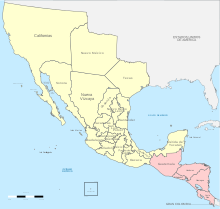
Costa Rica was one of the relatively more isolated populations of the New Spain viceroyalty
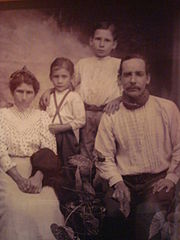
Boilerplate Costa Rican Family - Early Twentieth Century.
The colonial period began when Christopher Columbus reached the eastern coast of Costa rica on his fourth voyage in 1502. Numerous subsequent Spanish expeditions followed, somewhen leading to the first Spanish colony, Villa Bruselas in Republic of costa rica in 1524.[7]
During almost of the colonial period, Republic of costa rica was the southernmost province of the Captaincy General of Guatemala, which was nominally part of the Viceroyalty of New Espana (i.due east., Mexico), just which in exercise operated equally a largely autonomous entity within the Castilian Empire. Costa Rica'due south distance from the capital in Guatemala, its legal prohibition nether Spanish law to trade with its southern neighbors in Panama, and then office of the Viceroyalty of New Granada (i.e., Colombia), and the lack of resources such as gold and silver, fabricated Costa Rica into a poor, isolated, and sparsely inhabited region within the Spanish Empire.[8] Costa Rica was described equally "the poorest and most miserable Castilian colony in all America" by a Castilian governor in 1719.[9]
Some other important cistron behind Costa Rica's poverty was the lack of a significant ethnic population available for forced labor, which meant that most of the Costa Rican settlers had to work on their own land, preventing the establishment of large haciendas. For all these reasons Costa Rica was by and large unappreciated and overlooked by the Spanish Crown and left to develop on its own. The small landowners' relative poverty, the lack of a big indigenous labor force, the population'due south ethnic and linguistic homogeneity, and Costa rica's isolation from the Spanish colonial centers in United mexican states and the Andes all contributed to the evolution of an autonomous and individualistic agrestal society. Fifty-fifty the Governor had to farm his own crops and tend to his own garden due to the poverty that he lived in. An egalitarian tradition also arose. Costa Rica became a "rural democracy" with no oppressed mestizo or indigenous class. It was not long before Castilian settlers turned to the hills, where they found rich volcanic soil and a milder climate than that of the lowlands.[10]
Ethnic groups [edit]

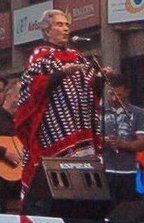


Claudia Poll, Euro-Costa Rican, Gold-Medalist Olympic Swimmer

Every bit of 2019[update] nearly Costa Ricans are primarily of Spanish ancestry with minorities of Nicaraguan, Italian, Portuguese, German language, French, British, Irish, Jamaican, Greek, mixed or other Latin American ancestries.
European migrants used Costa Rica to get across the isthmus of Central America besides to achieve the United states West Coast (California) in the late 19th century and until the 1910s (before the Panama Canal opened). Other indigenous groups known to alive in Costa rica include Nicaraguan, Venezuelans, Peruvian, Brazilians, Portuguese, Palestinians, Caribbeans, Turks, Armenians and Georgians.
Many of the showtime Spanish colonists in Costa Rica may have been Jewish converts to Christianity who were expelled from Spain in 1492 and fled to colonial backwaters to avoid the Inquisition. According to DNA tests from Ancestry.com and 23&me most of the original Costa Rican population from the Fundamental Valley have effectually 1-3% Sephardi Jewish Deoxyribonucleic acid.[11] The offset sizable group of cocky-identified Jews immigrated from Poland, beginning in 1929. From the 1930s to the early 1950s, journalistic and official anti-Semitic campaigns fueled harassment of Jews; however, by the 1950s and 1960s, the immigrants won greater acceptance. Most of the 3,500 Costa Rican Jews today are not highly observant, simply they remain largely endogamous.[12]
Republic of costa rica has four minor minority groups: Mulattos, Blacks, Amerindians and Asians. About 8% of the population is of African descent or Mulatto (mix of European and African) who are called Afro-Costa Ricans, English-speaking descendants of 19th century Afro-Jamaican immigrant workers.
In 1873 the Atlantic Railroad imported 653 Chinese indentured laborers, hoping to duplicate the success of rail projects that used Chinese labor in Republic of peru, Cuba, and the United States. Asians represent less than 0.v% of the Costa Rican population.
There are also over 104,000 Native American or indigenous inhabitants, representing 2.four% of the population. Nigh of them live in secluded reservations, distributed among 8 ethnic groups: Quitirrisí (in the Primal Valley), Matambú or Chorotega (Guanacaste), Maleku (northern Alajuela), Bribri (southern Atlantic), Cabécar (Cordillera de Talamanca), Guaymí (southern Costa Rica, along the Panamá border), Boruca (southern Costa Rica) and Térraba (southern Republic of costa rica).
Today, according to modern DNA test'south data the average Costa Rican (with 4 Costa Rican grand-parents) from the Central Valley is effectually 59% and 75% European, mostly Spanish, Basque or Portuguese, with around 15% - 35% Native American DNA from Central America or Colombia/Venezuela and 1-x% African particularly from Republic of cameroon, Senegal or Congo on average. Native American from other regions in the Americas, European Jewish, Italian, Irish, Asian/Middle Eastern DNA tin also be traced in part of the current Costa Rican population. Values vary drastically per region.
A considerable portion of the Costa Rican population is fabricated up of Nicaraguans.[13] There is also a number of Colombian refugees. Moreover, Costa Rica took in many refugees from a range of other Latin American countries fleeing civil wars and dictatorships during the 1970s and 80s – notably from Republic of el salvador, Chile, Cuba and recently from Venezuela.
Currently immigrants represent xv% of the Costa Rican population, the largest in Central America and the Caribbean. By 2019 the largest Immigrant Diasporas in Costa Rica are people from: Nicaragua, Republic of colombia, Honduras, El salvador, Venezuela, and United States.
Population [edit]
Approximately twoscore% live in rural areas and 60% in urban areas. The charge per unit of urbanization estimated for the period 2005–2010 is 2.3% per annum,[xiv] ane of the highest amid developing countries.
| Province | Province population | City | City population |
|---|---|---|---|
| San Jose Province | 1,345,750 | San Jose de Costa Rica | 350,535 |
| Alajuela Province | 716,286 | Alajuela | 46,554 |
| Cartago Province | 432,395 | Cartago | 156,600 |
| Puntarenas Province | 357,483 | Puntarenas | 102,504 |
| Heredia Province | 354,732 | Heredia | 42,600 |
| Limon Province | 339,395 | Puerto Limon | 105,000 |
| Guanacaste Province | 264,238 | Liberia | 98,751 |
Languages [edit]

Distribution of voseo:
spoken + written
primarily spoken
spoken, alternate with tuteo
absent
The primary language spoken in Costa rica is Costa Rican Spanish, one of the primary particularities of the Costa Rica Spanish is the usage of the 2d person singular pronoun vos (chosen voseo) or usted instead of tú. Some native languages are even so spoken in indigenous reservations. The near numerically important are the Bribri, Maléku, Cabécar and Ngäbere languages, some of which accept several thousand speakers in Costa Rica – others a few hundred. Some languages, such as Teribe and Boruca, have fewer than a thousand speakers. A Creole-English language language, Jamaican patois (too known as Mekatelyu), is spoken along the Caribbean coast. Nearly 10.7% of Costa Rica's developed population (xviii or older) also speaks English, 0.7% French, and 0.3% speaks Portuguese or German as a second linguistic communication. Mennonite immigrants to the country also speak Plautdietsch.
Religion [edit]
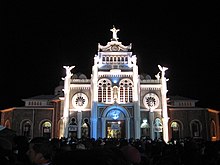
Basílica de Nuestra Señora de los Ángeles (Basilica of Our Lady of the Angels), during 2007 pilgrimage
Christianity is the predominant religion, and Roman Catholicism is the official country religion co-ordinate to the 1949 Constitution, which at the same time guarantees freedom of faith.[15]
According to the most recent nationwide survey of religion, conducted in 2007 by the University of Costa Rica, 70.v% of Costa Ricans are Roman Catholics, 44.9% of the population are practicing Catholics, 13.8% are evangelical Protestants, 11.3% report they do non take a religion, and 4.iii% belonged to another.
Because of the recent minor but continuous immigration from Asia (including West Asia/the Center East), other religions have grown, the most popular being Buddhism (because of a growing Han Chinese community of 40,000), and smaller numbers of followers of the Hindu, Jewish, Muslim and Baháʼí Faiths.
The Sinagoga Shaarei Zion synagogue [16] is about La Sabana Metropolitan Park in San José. Several homes in the neighborhood east of the park display the Star of David and other Jewish symbols.[17]
The Church of Jesus Christ of Latter-twenty-four hours Saints (Mormons) claim more than 35,000 members, and has a temple in San Jose that served as a regional worship center for Costa Rica, Panama, Nicaragua, and Honduras.[18] However, they represent less than one percent of the population.[19] [twenty]
Emigration and immigration [edit]
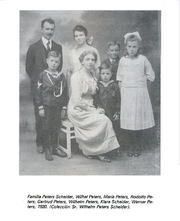
Family of German immigrants in Republic of costa rica.
Costa Rica's emigration is the smallest in the Caribbean Basin and is amongst the smallest in the Americas. By 2015 about just 133,185 (2,77%) of the country's people alive in another state every bit immigrants. The main destination countries are the United States (85,924), Nicaragua (10,772), Panama (seven,760), Canada (5,039), Espana (3,339), Mexico (ii,464), Germany (1,891), Italy (1,508), Republic of guatemala (i,162) and Venezuela (1,127).[21] In 2005, at that place were 127,061 Costa Ricans living in another country every bit immigrants. Remittances were $513,000,000 in 2006 and they represented ii.iii% of the country'south GDP.
Costa rica's immigration is amongst the largest in the Caribbean Basin. Immigrants in Republic of costa rica represent about 10.2% of the Costa Rican population. The chief countries of origin are Nicaragua, Colombia, United States and El Salvador. In 2005, there were 440,957 people in the state living every bit immigrants. Outward Remittances were $246,000,000 in 2006.
Run across besides [edit]
- Republic of costa rica
- Civilisation of Costa Rica
- Afro-Costa Ricans
- Italian Costa Ricans
- Chinese people in Costa Rica
- Latin Americans
- Costa Rican Americans
- Indigenous peoples of Costa rica
References [edit]
- ^ a b c d e f g h i j k l "Costa Rica - Emigrantes totales". expansion.com/ Datosmacro.com . Retrieved 4 June 2021.
- ^ "Imigrantes internacionais registrados no Brasil". www.nepo.unicamp.br. Archived from the original on 2020-ten-19. Retrieved 2021-08-20 .
- ^ "Las religiones en tiempos del Papa Francisco" (in Spanish). Latinobarómetro. April 2014. p. half-dozen. Archived from the original (PDF) on 10 May 2015. Retrieved 4 April 2015.
- ^ "Lawmakers vote to define Costa Rica as a multiethnic, plurinational land". The Tico Times. 28 August 2014. Retrieved 29 March 2015.
- ^ Costa rica es multirracial, último censo lo pone en evidencia
- ^ "Uppercase Facts for San José, Costa Rica". 20 July 2017. Archived from the original on 13 Apr 2020. Retrieved 6 Baronial 2017.
- ^ "Archived copy". Archived from the original on 2013-05-01. Retrieved 2016-02-05 .
{{cite spider web}}: CS1 maint: archived copy every bit title (link) - ^ "A Cursory History of Costa Rica: Colonial Times". Archived from the original on September 22, 2007. Retrieved 2007-12-21 .
- ^ Shafer, D. Michael (1994). Winners and losers: how sectors shape the developmental prospects of states . Ithaca, North.Y.: Cornell University Press. ISBN0-8014-8188-0.
- ^ "Costa rica – Cartago". Costarica.com. 2009-05-22. Retrieved 2010-06-26 .
- ^ "The Jewish Customs in Costa Rica". Retrieved 29 March 2015.
- ^ "Culture of Costa rica - history, people, women, beliefs, nutrient, customs, family, social, marriage". Retrieved 29 March 2015.
- ^ www.state.gov Background Annotation: Costa Rica – People
- ^ Central Intelligence Bureau (2011). "Costa Rica". The World Factbook. Langley, Virginia: Central Intelligence Agency. Retrieved 2011-10-04 .
- ^ "International Religious Freedom Report for 2017". www.land.gov. 2018. Retrieved 29 Dec 2018.
- ^ Centro Israelita de Costa rica, Comunidad Judía de Costa Rica, Costa Rican Jewish Customs
- ^ "Jewish Community in Republic of costa rica". Jcpa.org. Retrieved 2010-06-26 .
- ^ Costa rica Archived 2010-08-25 at the Wayback Motorcar. LDS Newsroom. Retrieved 2008-12-xiii.
- ^ "San José Costa rica LDS (Mormon) Temple". Ldschurchtemples.com. Retrieved 2010-06-26 .
- ^ "List of LDS (Mormon) temples in Central America and the Caribbean". Lds.org. Retrieved 2010-06-26 .
- ^ Costa Rica - Emigrantes totales (in castilian) Según los últimos datos publicados Costa Rica tiene 133.185 emigrantes, lo que supone un 2,77% de la población de Costa Rica. Si miramos el ranking de emigrantes vemos que tiene un porcentaje de emigrantes medio, ya que está en el puesto 44º de los 195 del ranking de emigrantes.
Source: https://en.wikipedia.org/wiki/Costa_Ricans
Posted by: landissclows1999.blogspot.com
0 Response to "What Is The Ethnic Makeup Of Costa Rica?"
Post a Comment